
If you’ve ever watched a foundation crack, a slab heave, or a doorframe shift out of square — you already know what expansive clay soil can do. What you might not know is that the damage starts long before you see it, and it starts beneath your feet.
My name is Tim Miller, and I work with Stabiltech Soil Stabilization here in the DFW area. We’ve spent years developing and refining a process that treats the root cause of foundation movement — not the symptoms. In this post, I’m going to walk you through exactly how our STX90 hand injection process works, why the details matter, and what it means for both homeowners dealing with existing problems and builders who want to get ahead of them entirely.
“The damage starts long before you see it — and it starts beneath your feet.”
The Real Problem: What Expansive Clay Soil Does to Your Foundation
North Texas sits on some of the most expansive clay soil in the country. This isn’t a minor inconvenience — it’s one of the leading causes of foundation damage in the entire region. Here’s what’s actually happening beneath your property.
Expansive soils cause more than $15 billion in damage annually in the US — more than twice the cost of all other natural disasters combined. Source: HUD Cityscape
Clay soil is not like sand or gravel. It has a molecular structure that actively attracts and holds water. When it rains or sprinklers run, clay absorbs moisture and expands — sometimes dramatically. When conditions dry out, that same soil shrinks and contracts. This cycle, repeated season after season, year after year, creates constant movement beneath your foundation.
That movement isn’t uniform. Different areas of your pad may absorb moisture at different rates — especially around the perimeter where water infiltration is highest. The result is differential movement, which is exactly what causes slabs to crack, foundations to heave, and walls to separate.
For homeowners, this means cracked walls, sticking doors, uneven floors, and in serious cases, structural compromise. For builders and developers, it means warranty claims, callbacks, and reputation risk — all traceable back to what was beneath the slab before the concrete was ever poured.
“Differential movement — not uniform settling — is what causes cracks. And it starts with the soil.”
Why Treatment — Not Just Engineering — Is the Answer
There’s a common misconception that you can engineer your way around bad soil. Post-tension slabs, deeper footings, and drainage improvements all help — but none of them address what the soil itself is doing. As long as the clay beneath your foundation retains its ability to bond with water, movement is a matter of when, not if.
What Stabiltech does is different. Instead of working around the soil, we change it. Our STX90 ionic solution modifies the clay at a molecular level, permanently reducing its ability to attract and hold water. Once treated, the soil becomes far more dimensionally stable — it still allows water to pass through, but the clay particles no longer bond with it the way untreated soil does.
The result is a foundation base that behaves consistently regardless of moisture conditions. That consistency is what protects structures long term.
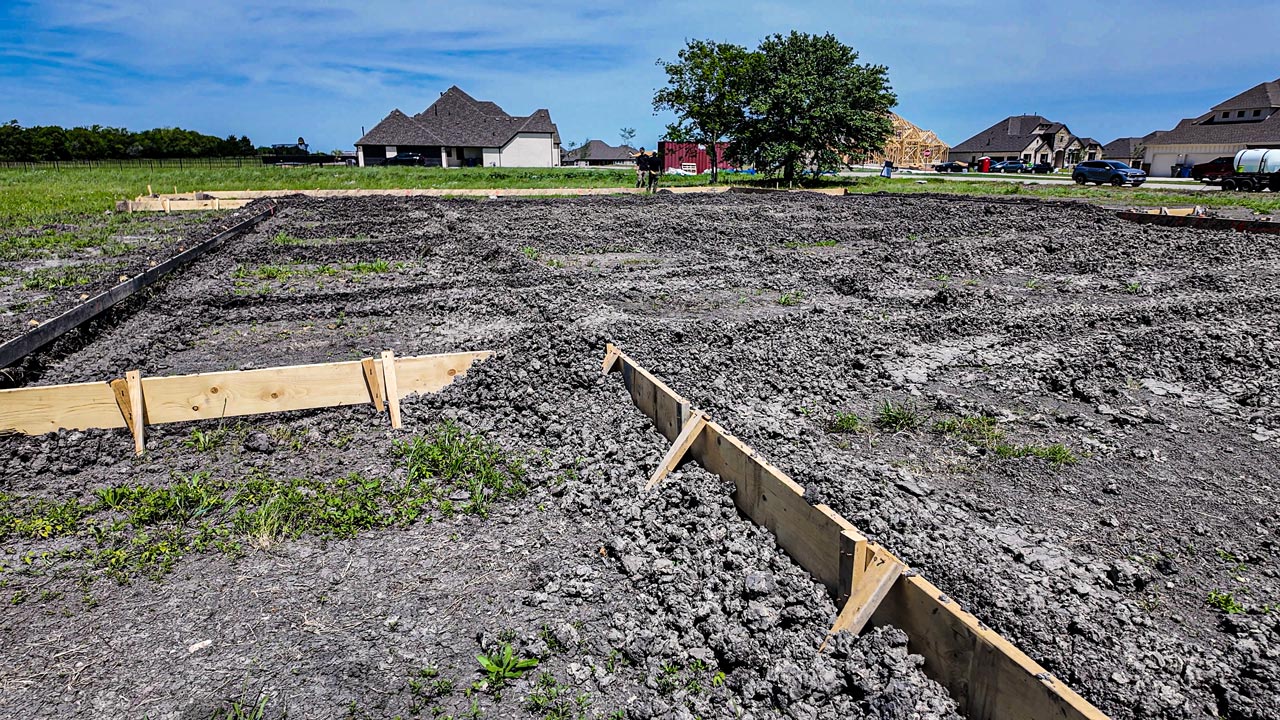
Pre-construction soil treatment is the most cost-effective window — before the slab is ever poured.
Alt: Residential foundation pad with concrete forms set and soil prepared for STX90 ionic soil stabilization treatment in DFW Texas
How STX90 Works at the Molecular Level
Clay particles naturally carry a negative surface charge. That charge is what makes them attract water molecules — it’s essentially a magnetic relationship between the soil and moisture. The more water that bonds to the clay, the more it expands. Remove the moisture, and it contracts.
STX90 introduces ionic compounds that neutralize that negative surface charge. Once neutralized, the clay particle no longer has the electrochemical attraction that pulls water in. Water still moves through the soil — we’re not creating an impermeable barrier — but it moves around the clay particles rather than bonding to them.
This isn’t a temporary fix or a coating that wears off. The ionic exchange that happens at the particle level is a permanent modification. Our team has refined this formulation over 30 years of field application across a wide range of soil conditions, developing a more advanced ionic concentrate than what’s typically available in the industry.
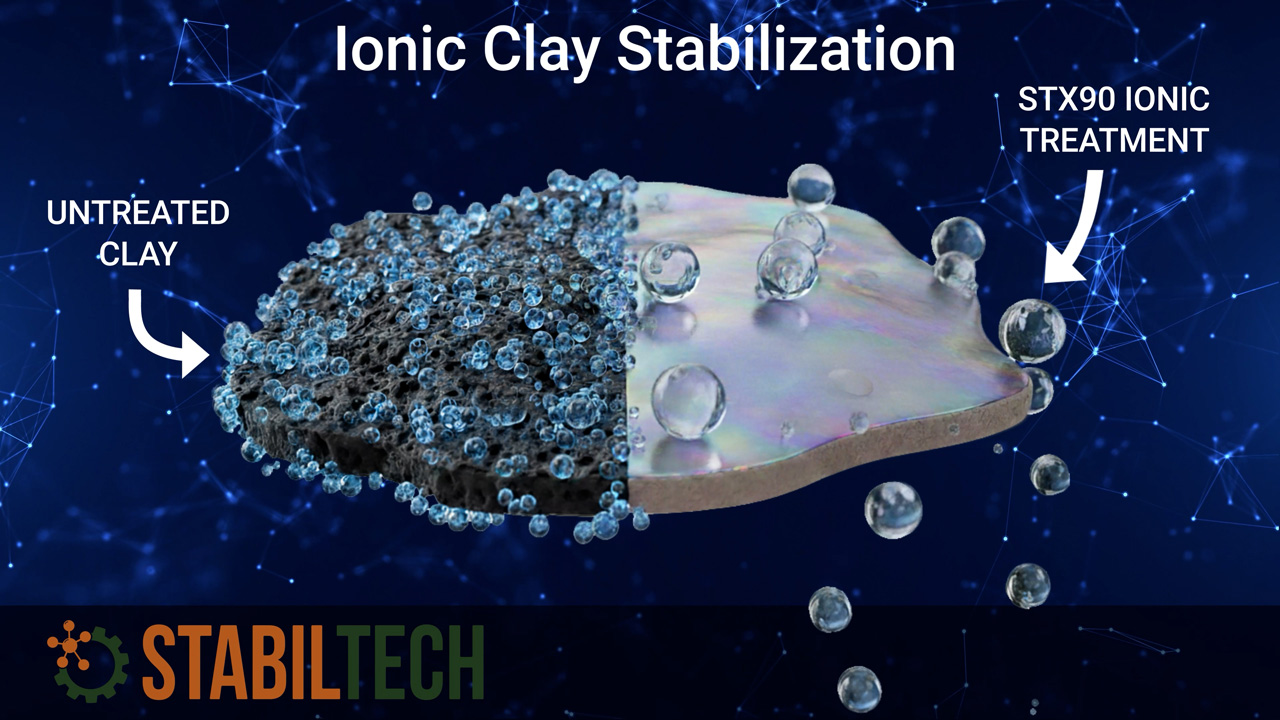
STX90 neutralizes the negative charge on clay particles — water no longer bonds to the soil, it simply passes through.
Alt: Diagram showing untreated clay absorbing water versus STX90 treated clay with water passing freely
“30 years of field application. A more advanced ionic concentrate. Better long-term results.”
The Hand Injection Process: How We Actually Do It
Understanding the science is one thing. But the application process is where it all comes together — and where the details really matter. Here’s exactly how we execute a treatment.
Soil Evaluation
We evaluate swell potential and Potential Vertical Rise (PVR) to determine the treatment depth and pattern spacing needed for your specific soil conditions.
The Equipment
We use 10-foot wand rods with a closed tip and perforated discharge section. Solution exits radially through the sides — promoting lateral spread and a wider treatment zone per injection point.
The Overlapping Pattern
We work across the entire pad area in a deliberate pattern. Each injection point creates a radial treatment zone, spaced so those zones overlap — building a continuous treated mass rather than isolated pockets.
Staged Depth Stops
We inject at multiple depths as we go down, ensuring the treatment reaches the entire active zone vertically — not just at the surface.
Refusal — The Built-In Quality Check
When water begins returning from the injection hole, that’s refusal. It confirms the soil at that location has taken all it can hold. We move to the next point only after refusal is achieved.
“Refusal is confirmation — not a problem. It means the soil has taken everything it can hold. That’s how we know it’s working.”
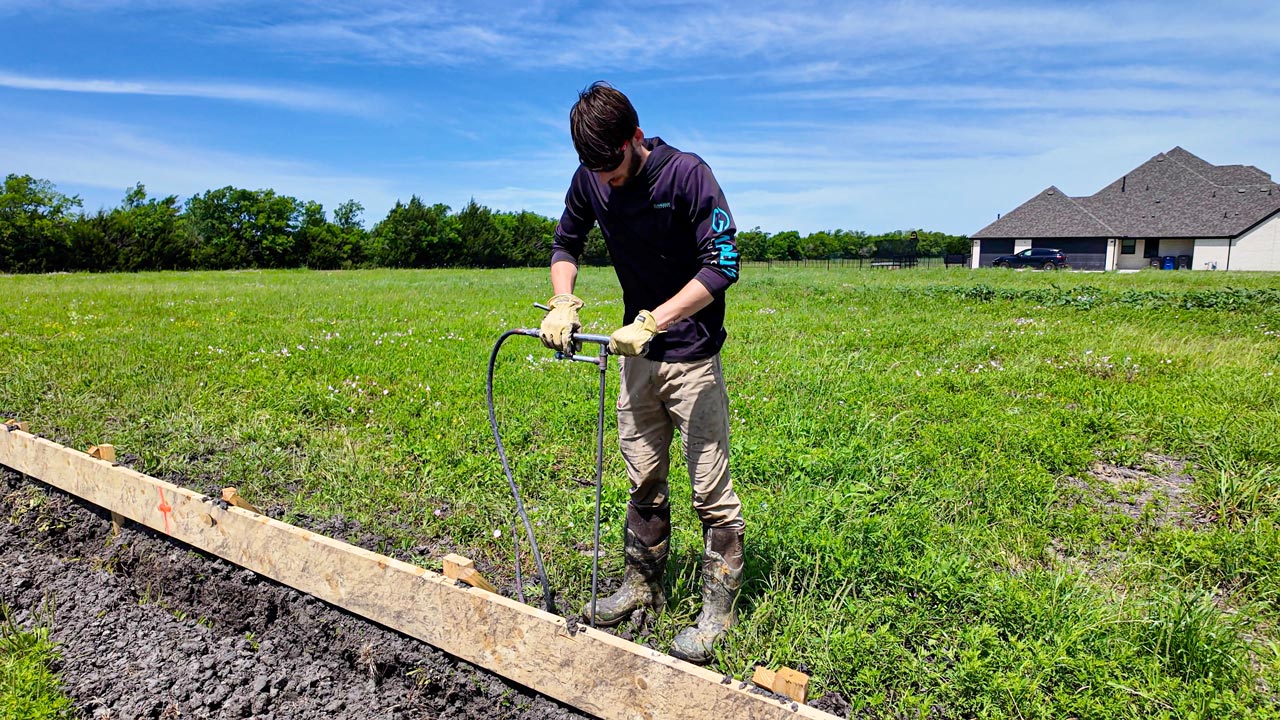
A Stabiltech technician working a pre-construction injection pattern along a foundation form board — treating the soil before the slab is ever poured.
Who This Is For
- Full pad access before pour
- Lower cost than post-construction remediation
- Consistent foundation performance from day one
- Reduced warranty and callback risk
- Documentation for buyers as a quality differentiator
- Reduce ongoing movement damaging your structure
- Stable base before foundation repair work
- Address root cause, not just symptoms
- Extend the life of existing repairs
- Permanent solution — not a recurring treatment
Frequently Asked Questions
How deep does the injection go?
Our hand injection rods reach up to 10 feet deep. We work in staged stops to ensure treatment is distributed throughout the depth of the active clay zone, not just at the surface.
How long does the treatment last?
The ionic modification that STX90 creates at the particle level is permanent. This isn’t a treatment that wears off or needs to be reapplied. Once the clay particles have been neutralized, that change is durable.
Will it affect drainage on my property?
No. STX90 does not create an impermeable barrier. Water still moves through the treated soil — it simply no longer bonds to the clay particles the way it did before. Drainage patterns are not negatively affected.
Is STX90 safe for the environment?
Yes. STX90 uses naturally occurring ionic minerals that are non-toxic and non-hazardous. There is no risk to surrounding vegetation, groundwater, or adjacent structures.
How do I know if my soil needs treatment?
Key indicators include cracking in walls or ceilings, sticking doors or windows, uneven floors, or visible cracks in your slab or foundation. We evaluate soil swell potential and Potential Vertical Rise (PVR) to determine the appropriate treatment approach.
Can you treat soil after a foundation has already been repaired?
Yes, and in many cases we recommend it. Foundation repairs address the structural damage but not the underlying soil movement. Treating the soil after repair helps protect the investment you’ve made in the repair itself.
Do you serve areas outside Dallas-Fort Worth?
We serve the broader North Texas region including Dallas, Fort Worth, Austin, Houston, San Antonio, Victoria, and Corpus Christi. Contact us to discuss your specific location.
Read Full Transcript

00:00 — Residential Site and Moved Build Area
Okay, so I’m out at a residential construction site. They had done soil injection previously, and after the soil injection, they had to move the whole area. So they went 20 feet back and then 20 feet to the right.
00:18 — Why Hand Injection Covers the Shifted Pad
And so what we’re doing is we’re coming in with a hand injection process to make sure we cover all of that area, just in case — we want to make sure that we have good solid ground to build a foundation.
00:32 — Ten-Foot Rods and Incremental Injection
This is a wand injection process. These ones are about ten feet. And we go down in increments.
00:41 — What Refusal Looks Like in the Field
And what we’re doing is, as we go down, we’re actually waiting for refusal. And refusal is what happens when water actually comes out. You can kind of see it’s coming out right here. So the water actually comes out of the hole. Sometimes it’ll come out of previous holes that were injected.
01:08 — Overlap Pattern Across the Foundation Area
Once we get that refusal, then we know we’ve reached our maximum for that spot, and then we move over and do the same thing at another spot. We’re not treating one hole at a time and hoping for the best. We’re moving across this pad in a pattern so each injection overlaps the next one. With hand injection we use ten-foot rods, work in stages, and watch for refusal — so we know that spot has taken what it can. Then we move over and repeat it. The goal is full coverage under the foundation area, so the soil acts more consistently across the whole pad.
01:34 — How STX90 Changes Clay Behavior
The stabilizer changes the clay chemistry, so it’s far less likely to hold water. That swell-shrink cycle is what drives heaving and contraction, especially around the perimeter. Once a soil is treated, it becomes much less reactive to moisture and a lot more stable under the foundation.
One of the cool things about our solution is it’s STX90 — that’s what we’re calling it. And it does some really cool stuff on a molecular level. When it gets to the clay, it’s changing the polarity of the clay so that what happens is water will never bond with the clay again.
02:15 — Water First, Then Solution Locks Down Swell
The first thing that we’re doing is we’re injecting the water that’s expanding the clay to its max. And then when the solution hits it, the solution is going to cause the clay to not bond with water anymore.
02:28 — Reduced Expansion Means Less Structural Damage
Now, that doesn’t mean we completely take away the expansive cycle — you’re still going to expand when you have sprinklers and rain. But it’s not going to expand to the effect where it’s going to cause damage to any structures. It doesn’t make an enclosed system. Water still flows through it. It just causes the clay to stay exactly where it is. So water goes around the clay molecules. And what that means is you are going to have a foundation that is not going to crack under pressure from expansive clay.