
Post-tension slabs are standard across Texas.
But they do not solve the root problem.
In high-plasticity clay soils, movement starts below the slab — not in the concrete. The real question is whether your foundation is resisting movement or preventing it.
This field report breaks down why post-tension alone does not stop soil movement — and what actually reduces PVR before a foundation is designed.
Why Texas Foundations Fail: The Real Problem Is the Soil
Across the Blackland Prairie, high-plasticity CH clay dominates the subsurface.
This soil is moisture-sensitive, chemically reactive, and prone to severe expansion and shrinkage. When it absorbs water, it expands. When it dries, it contracts.
That repeated movement generates Potential Vertical Rise (PVR) — the upward force capable of lifting slabs, cracking walls, and misaligning doors and windows.
Concrete does not fail first. Soil movement does.
How a Post-Tension Slab Actually Works
Post-tension foundations are common throughout Texas because they improve slab strength and crack resistance.
- Tendon Layout: Steel cables in protective jackets are installed in a grid pattern, typically spaced around every 4 feet, with additional reinforcement at grade beams.
- Concrete Pour: Concrete is poured over the tendons while the steel remains isolated inside the sheath.
- Hydraulic Tensioning: After curing, calibrated hydraulic equipment stretches the cables.
- Locking and Compression: The slab is compressed into a stronger monolithic unit.
Post-tension increases slab strength.
It does not reduce soil expansion, shrinkage, or PVR.
Why Post-Tension Foundations Still Move in Texas
Expansive clay can generate major uplift pressure during a heavy swell cycle.
A post-tension slab can hold itself together and reduce visible cracking, but it does not stop heave, eliminate PVR, or prevent differential moisture movement beneath the structure.
If the center of the home absorbs more moisture than the perimeter, the slab may dome. If the perimeter becomes wetter, it may dish.
The slab may not fail immediately — but it still moves.
That movement leads to:
- Interior sheetrock cracks
- Tile separation
- Door and window misalignment
- Plumbing stress
- Long-term structural distress
That is reactive construction.
The Smarter Strategy: Stabilize the Soil Before You Pour
The primary defense is the soil. Reinforcement is secondary.
StabilTech’s STX90 ionic soil stabilization is designed to permanently reduce expansive clay behavior at the molecular level before final foundation design.
STX90 Ionic Soil Stabilization: How It Works
- Deep Pressure Injection: Solution is injected up to 15 feet into active clay strata — targeting the zone responsible for foundation movement.
- Molecular Alteration: The ionic solution changes clay particle polarity, permanently reducing water attraction.
- PVR Reduction: Swelling potential is reduced and verified through post-treatment testing.
- Engineering Verification: Foundation design is based on stabilized soil data, not worst-case assumptions.
This shifts foundation performance from reactive design to engineered control.
Post-Tension vs Soil Stabilization: A Clear Comparison
Here is the actual difference between reinforcing concrete and stabilizing soil:
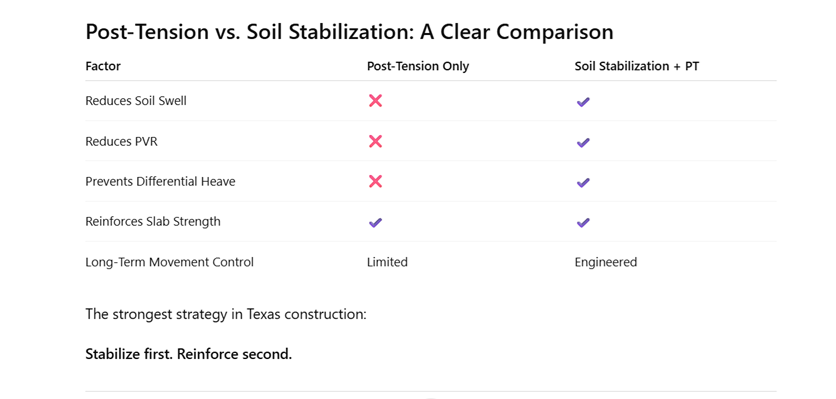
Builders and Developers: Why This Matters
- Engineering Reliability: Design based on stabilized soil data — not worst-case assumptions.
- Reduced Warranty Claims: Expansive soil movement drives long-term structural issues.
- Liability Control: Stabilized soil reduces long-term risk exposure.
- Cost Efficiency: Lower PVR can reduce over-engineering requirements.
Common Questions
Is a post-tension foundation good for Texas clay?
Yes — for reinforcement. It does not eliminate soil movement.
Why do post-tension slabs still move?
Because expansive clay expands and contracts under moisture changes, generating differential heave beneath the slab.
What is PVR in foundation design?
Potential Vertical Rise measures how much soil may expand under moisture changes.
What is the best foundation strategy for expansive clay?
Soil stabilization combined with structural reinforcement.
The Bottom Line
You cannot reinforce your way out of a soil chemistry problem.
Steel strengthens concrete. STX90 stabilizes the earth.
Before you pour concrete, evaluate the soil.
Foundation performance is determined below grade — not in the slab.
STABILTECH: PERMANENT SOIL STABILIZATION
Texas Build Labs is sponsored by StabilTech. We solve the “Texas Clay” problem at the molecular level.
In the Blackland Prairie, high-plasticity CH clays destroy foundations. StabilTech’s STX90 ionic injection permanently stops the swell-shrink cycle and reduces Potential Vertical Rise (PVR) without excavation.
- Tech: Deep pressure injection (up to 15 ft).
- Safety: Non-toxic, food-grade mineral solution.
- Region: Serving DFW, Austin, Houston, San Antonio, and beyond.
Connect with a Dirt Expert:
Web: stabiltechsoil.com
Phone: (469) 908-1989
Email: sales@stabiltech.com
Read Full Video Transcript
The Mechanics of Post-Tension Cables
The post-tension cable is secured on one side and runs through the entirety of the foundation. These cables are housed in a PVC-coated jacket. The jacket is flexible enough for installation but rigid enough to allow the concrete to bond to the exterior without interfering with the internal steel.
On one end, the cables are secured directly to the rebar. On the opposite side, the cables protrude from the edge of the slab. Once the concrete reaches a specific curing stage, the supply house uses a calibrated machine to hook into these exposed cables and apply the necessary tension.
Why the PVC Jacket is Critical
A common question involves what happens if concrete gets inside and touches the cable. That is the purpose of the PVC jacket—it acts as a barrier. The concrete secures the jacket in place, but because it never touches the steel, tension can still be applied through the cable.
The crew will return to tension the entire grid, which is installed in both directions to create a structural cross-section.
The Final Tensioning Process
In this layout, cables are spaced roughly every four feet. In the beams and footers, multiple cables are grouped together for additional reinforcement. The final step involves a manufacturer’s representative using a calibrated machine to tighten these tendons.
As the cables tighten, they lock the foundation together as a monolithic unit. The goal is a secured, high-strength slab that resists cracking and holds the structure together as a single mass.
Addressing the Root Cause: Soil Stabilization
Regardless of the foundation type—whether pier and beam or post-tension—the critical step is stabilizing the ground underneath. A strong foundation cannot stop the ground from heaving. The soil itself must be stabilized to eliminate movement.
On this project, StabilTech Soil Solutions injected the ground with the STX90 ionic solution. After injection, post-treatment test results were sent to the structural engineer, who designed the foundation based on those improved soil conditions.
This process ensures a stable base and reduces the risk of long-term movement, allowing the foundation to perform as intended.